
AI Disruption in Healthcare Jobs: Are PAs and NPs Actually Safe?
By Kristin Burton, PA-C | Millionaires in Medicine
The projections are impossible to ignore. Depending on which study you read, AI is expected to displace somewhere between 80 million and 800 million jobs globally within the next five years. Every industry is watching. Every professional is quietly doing the math on their own career.
As medical professionals, most of us have operated with a quiet confidence that we're different. That the human complexity of patient care: the empathy, the nuance, the hands-on nature of what we do, would insulate us from the wave hitting everyone else.
I used to believe that too. I'm not so sure anymore.
The Fields We Thought Were Safe Are Being Watched Closely
For years, the conversation around AI and medicine has centered on a single metric: automatable hours. What percentage of a given job could theoretically be handled by a machine?
By this measure, radiology and pathology have long been flagged as the most vulnerable. Both are heavily pattern-recognition-based, image-heavy fields where AI has already demonstrated diagnostic accuracy that rivals (and in some studies, surpasses) trained specialists. Anesthesiology has also been on the watch list for years.
Fields requiring procedural capacity (critical care, surgical subspecialties) have historically been deemed the safest. The argument being that a robot can't scrub in, a machine can't place a chest tube, and no algorithm can manage a crashing patient in real time.
That last assumption just got more complicated.
The Robot Surgery That Changed My Thinking
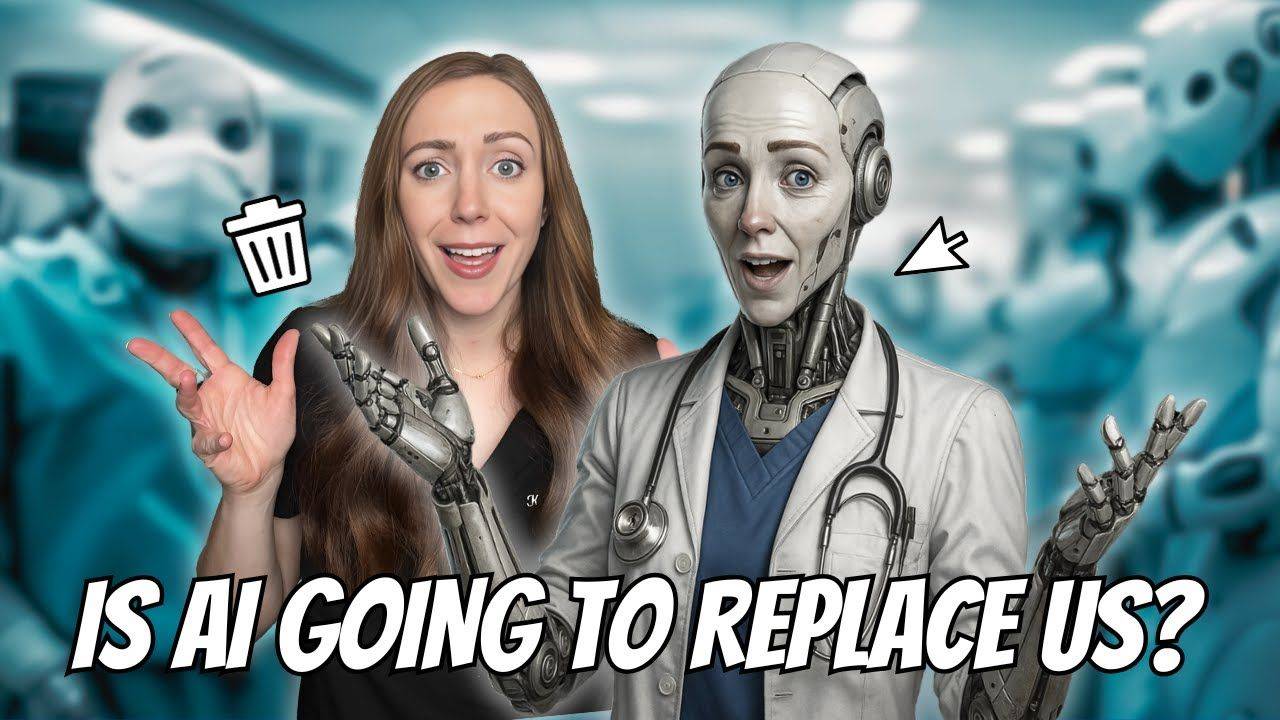
At UC San Diego, surgeons recently used teleoperated humanoid robots to perform a live cholecystectomy on a pig. The first pass was a robot performing the surgery with a human surgeon first assisting. The second was a two-robot team.
Yes, there was still a surgeon in the background operating via telerobotics. This wasn't a fully autonomous procedure. But here's what stopped me: humanoid robots are already cleaning facilities, doing laundry, and working assembly lines with increasing dexterity and reliability. The leap from those tasks to more complex procedural work is not as large as we'd like to believe — and it's getting smaller every year.
The question I had to sit with: if the "procedural capacity" argument was the last line of defense for medical professionals feeling safe from AI disruption, what happens when that line starts to move?
The Tools Already in Your Hospital
Here's what makes this more than theoretical. The displacement of medical roles by AI isn't a future event. It's already happening in slow motion, disguised as efficiency tools.
Consider what's already FDA-cleared and in active use:
- Eko Health's "Low EF AI" — a stethoscope that can detect cardiomyopathy
- Exo Imaging — a tool that generates a quantitative assessment of left ventricular ejection fraction from a single parasternal long axis view (hands down the easiest ultrasound view to obtain)
- Qure.ai — a platform that reads chest X-rays comprehensively with AI
There are currently over 1,500 authorized AI diagnostic devices. That number is growing.
Now put those three cardiology tools together and think through this scenario: a single individual — no diagnostic training required — walks into an emergency department room. They place a smart stethoscope on a patient's chest. They grab one ultrasound view. They take a chest X-ray. The AI assembles those data points alongside the patient's labs and arrives at a diagnosis of new-onset congestive heart failure.
This is not science fiction. This is a reutilization of tools that already exist, today, and are already cleared by the FDA.
What the Research Is Actually Saying
A study published in Nature Medicine this year did something that raised serious questions about how we think about AI in clinical settings. Researchers pitted general-purpose large language models — GPT-5.2, Gemini 3.1 Pro, Claude Opus 4.6 — directly against FDA-cleared clinical AI tools like OpenEvidence and UpToDate Expert AI. They used real physician-submitted clinical questions as the benchmark.
The general-purpose models outperformed the FDA-cleared tools across the board.
This raises an uncomfortable question: what does FDA clearance actually certify? If a general-purpose AI that wasn't built specifically for medicine is outperforming tools that went through the full regulatory process, then the regulatory moat we assumed was protecting the pace of AI adoption in medicine may be thinner than we thought.
The slow rollout of AI in clinical practice — slower than almost every other industry — has led a lot of medical professionals to assume we're immune. We're not immune. We're just delayed.
So Are We Safe?
Here's my honest answer: the likelihood of my clinical practice remaining completely unchanged over the next 10 years is close to zero.
That's not a doom statement. It's a strategic one.
The medical professionals who will be most at risk are not necessarily those in the "highest automatable hours" fields — though that's still a relevant lens. The ones most at risk are the ones who treat their clinical skills as their only asset. Who assume their diagnostic training, their procedural experience, and their current role description will be enough to protect their income and career indefinitely.
They won't.
The Shift That Actually Protects You
Here's the reframe that changes everything: AI fluency is not a threat to your income. It is your next income lever.
Clinicians who are already using AI tools in their practice are seeing approximately 50% gains in documentation efficiency. If you practice medicine right now, you know documentation consumes roughly half your working time. A 50% efficiency gain there — with zero change to your patient interactions — means you can see more patients, generate more revenue, and make a far stronger case for productivity-based compensation structures.
That's the direct line: AI efficiency → higher output → stronger negotiating position → higher income.
On the other side, clinicians who are not adapting will increasingly find themselves at a disadvantage — not because AI replaced them, but because their colleagues who embraced it are simply more valuable to an employer or practice.
The McKinsey data on automatable hours by profession is worth knowing. General practitioners clock in around 12% automatable hours. Specialties with heavy procedural demands — surgical subspecialties, critical care — remain lower. Psychiatric fields also trend lower, given how fundamentally empathy-based that work is. AI is not well-suited to replicate the therapeutic relationship at the core of psychiatry.
But even in the safest fields, the calculus is the same: the clinicians winning are the ones using AI as a tool, not waiting to see if it comes for them.
What You Can Actually Do About It
This is the part most people skip past — they read the scary headlines, feel anxious, and move on without changing anything. Don't do that.
- Know your automatable hours. Look honestly at your daily workflow. What percentage of your time is documentation, data review, or pattern-recognition tasks? That's where AI will move first — and also where you can gain efficiency fastest if you start using tools now.
- Learn the tools in your specialty. They already exist. In cardiology, in radiology, in primary care, in emergency medicine — there are FDA-cleared and general-purpose AI tools that your colleagues are already using. The learning curve is not steep. The cost of not learning is high.
- Position for productivity-based pay. If AI can make you measurably more efficient, that efficiency should translate into income — but only if your contract rewards output. Straight salary structures cap the upside. Productivity-based models, RVU bonuses, and revenue-sharing arrangements allow your AI-assisted efficiency to compound into real earnings growth.
- Build your financial moat now. Regardless of how AI reshapes your specific role, 3 to 6 months of cash reserves, a meaningful gap between income and expenses, and income diversification outside your primary clinical job are the structural protections that make disruption survivable rather than catastrophic. Expert witness work, medical writing, pharmaceutical speaking, consulting, academia — your clinical knowledge has value well beyond the exam room.
- Build the CV now for the pivot you might need later. The professionals who transition most successfully into non-clinical roles aren't the ones who decided to pivot and then scrambled to build credentials. They're the ones who spent years building adjacent experience — teaching a few hours, speaking for a device company, writing, consulting — while still in clinical practice. When the time comes to make a move, they're already the obvious candidate.
The Bottom Line
Will your entire role in medicine disappear? Probably not. But the assumption that your current skillset alone will sustain your income trajectory over the next decade is one worth questioning seriously.
The medical professionals who will thrive in the AI era are not the ones who ignored it. They're the ones who learned it, used it, built financial resilience around their careers, and positioned themselves so that when the landscape shifted — as it always does — they were already ready.
This is something I've been thinking about, and talking about, for a while now. If you want to go deeper on exactly how to position yourself — both professionally and financially — I put together a full breakdown in the video below.
▶ Watch: Will AI Take Your Job as a PA or NP — And What to Do About It
In it, I walk through the automatable hours framework, the financial moats every medical professional needs to build right now, how to negotiate compensation structures that reward AI-driven efficiency, and the income diversification strategies that protect you no matter what comes next.
Kristin Burton is a practicing PA in cardiology and critical care and the founder of Millionaires in Medicine. She became a millionaire at 31 on a PA salary. Learn more at millionairesinmedicine.com
Author

Kristin Burton
Founder
Kristin Burton is a pulmonary/critical care PA and founder of Millionaires in Medicine. She paid off $161,000 in student loan debt in 16 months, and then went on to become a millionaire at 31.

Have insurance needs?
Look no further than Protuity for your life and disability insurance.

Navigating physician contracts can be overwhelming. Resolve offers a personalized legal experience to equip you with the tools and support needed to secure the best terms for your career.
Use code MIM15 to receive a 15% discount at checkout.

Doc2Doc helps healthcare providers explore personal loan options to consolidate debt, simplify payments, and potentially lower what they’re paying in interest.
Prepping for EORs, PANCE, PANRE, or EOC?
Get the support you need right now to stop second guessing your test answers, ditch your anxiety, and learn the 7 critical test-taking skills you need to knock your PA exams out of the park.