
PA Specialties Salary 2026: The Highest and Lowest Paying Careers — And What Actually Builds Wealth

PA Specialties Salary 2026: The Highest and Lowest Paying Careers — And What Actually Builds Wealth
I became a millionaire at 31 on a PA salary.
Not a physician salary. A PA salary (in cardiology and critical care) built by choosing the right specialty, understanding my contract, and getting strategic with investing.
Most PA salary articles are going to stop at the number. They'll show you a ranking, hand you a table, and call it a day. But the number on your offer letter is not the same as the money you actually keep. And the money you keep is not the same as the wealth you build.
This is the full picture: the highest and lowest paid PA specialties in 2026, the states where your dollar goes furthest, the contract structures that separate the top earners from everyone else, and the compensation levers most PAs never think to negotiate… or even ask about.
Quick Answer: Highest-Paid PA Specialties in 2026
Based on data from Marit Health, the top five earning PA specialties in 2026 are:
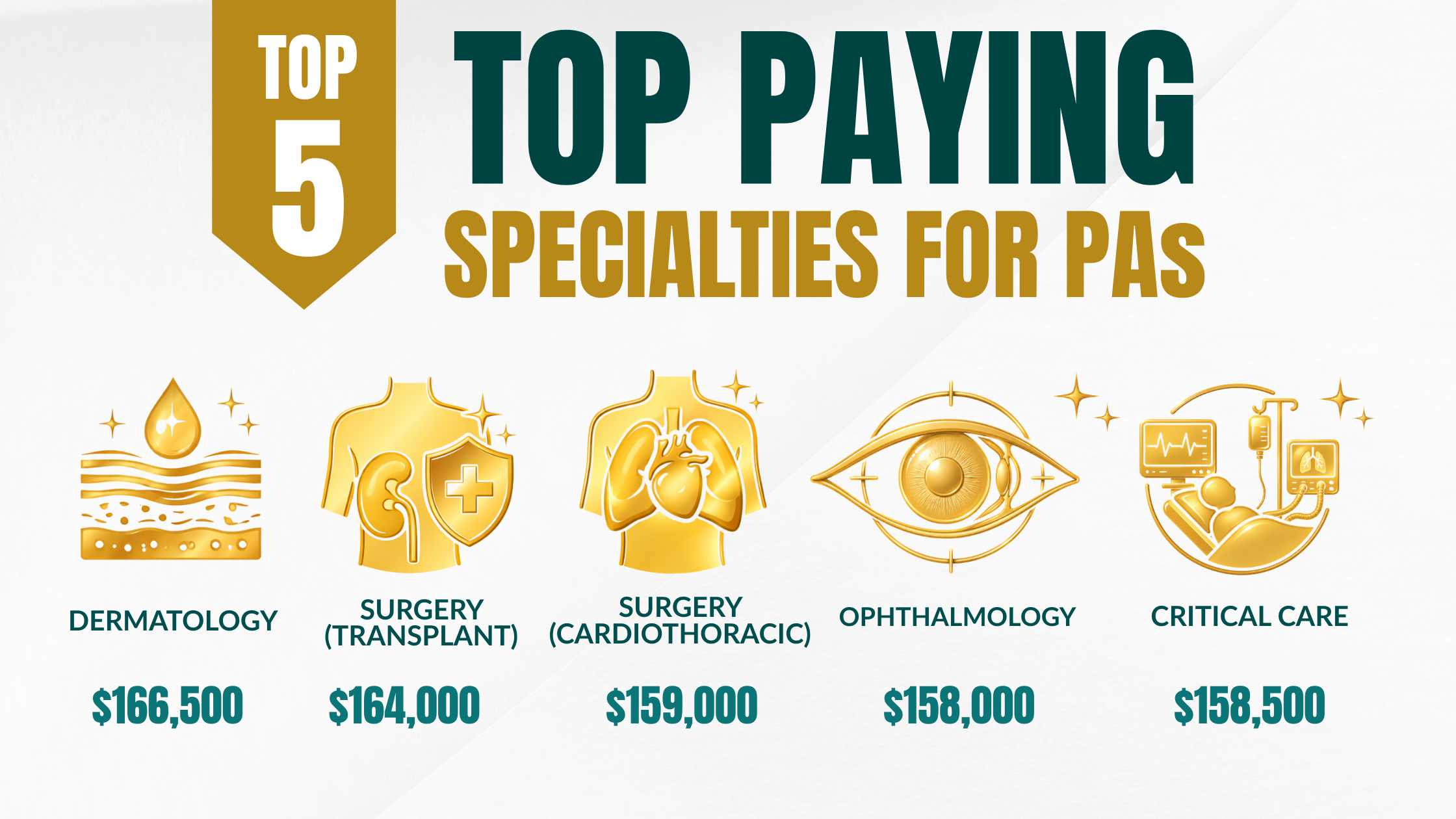
The pattern is the same across every top-earning specialty: procedural capacity pays. Specialties tied to measurable clinical output (procedures, revenue, RVUs) create more room to reward high-performing PAs. Whether you like it or not, having the ability to do procedures tends to translate directly into more money.
Lowest-Paid PA Specialties in 2026
Before the top earners, let's look at the other side. According to Marit Health, these specialties sit at the bottom of the earnings range for PAs:
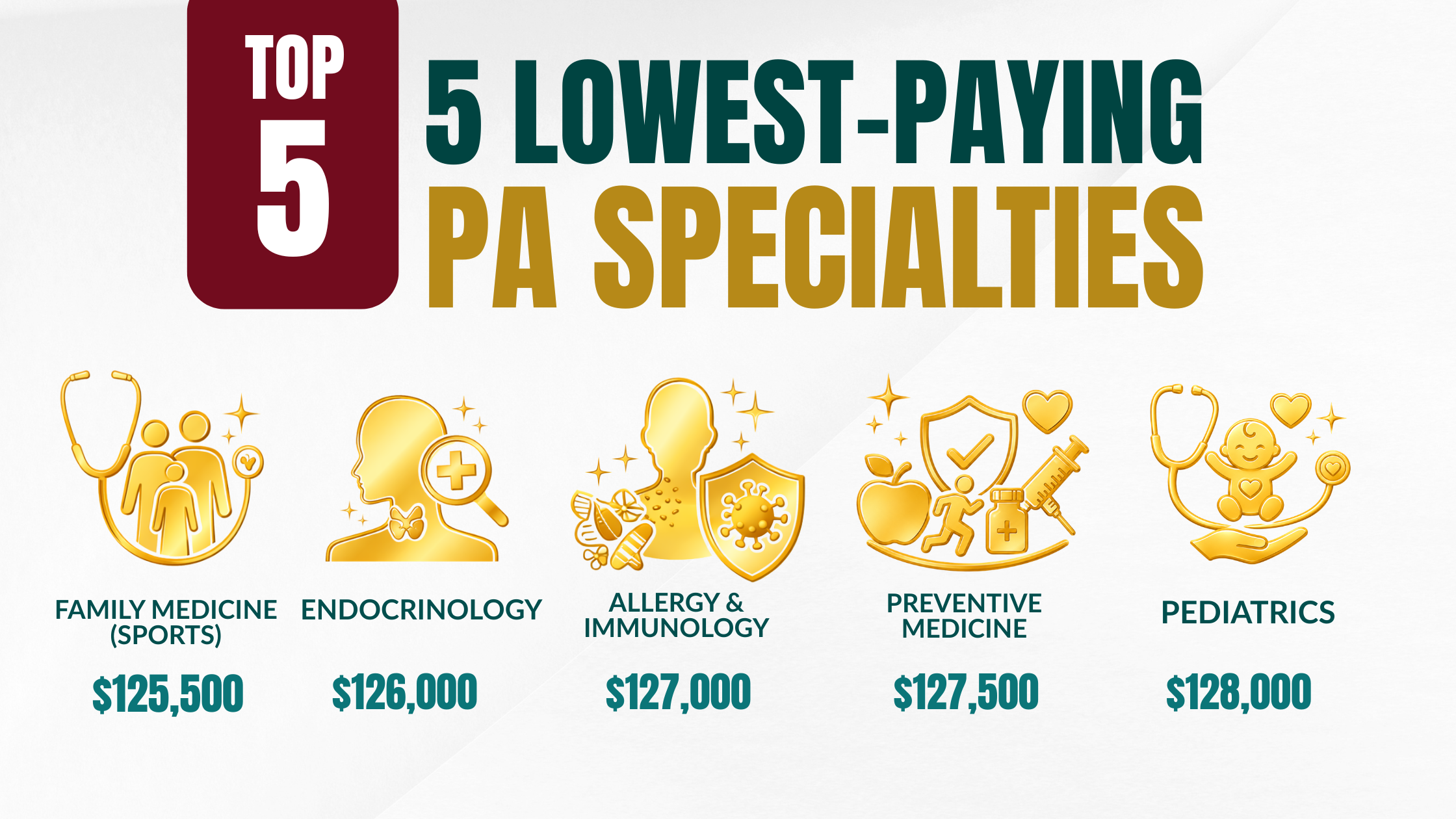
These are important specialties. PAs doing this work matter. But if your financial goals include aggressive student loan payoff, early investing, or building real wealth, you need to understand the tradeoff going in.
A lower-paying specialty can still work — but it demands more intention around every other variable: location, contract, total compensation, and outside investing strategy. The specialty is one part of the equation. It is not the whole equation.
#1 Highest-Paid PA Specialty in 2026: Dermatology
Dermatology is not a surprise. It ranks at the top year after year, and 2026 is no different.
According to Marit Health, dermatology PAs earn an average total compensation of $166,000. But that average understates the ceiling. Dermatology PAs on productivity-based contracts — particularly percent-of-collections models — regularly earn $200,000 to $300,000 or more, because their income grows directly with the revenue they generate.
That's the key variable: contract structure. Two dermatology PAs in the same clinic can earn very different amounts based solely on how their contracts are written. More on that below.
Dermatology is also competitive to break into precisely because the income potential is so well known. If your number one mission as a PA is to earn the absolute most money, dermatology may be your answer. Just understand that getting in — especially as a new grad — takes real strategy.
#2 and #3: Transplant Surgery and Cardiothoracic Surgery
Numbers two and three are both surgical subspecialties, and that's not a coincidence.
Surgical subspecialties pay well because the clinical value is measurable and the demands are real: OR time, first assisting, call coverage, high-acuity patients, specialized procedural skills. Each of those factors gives PAs more leverage at the negotiating table — and more justification for employers to pay more.
If dermatology isn't your path but income is still a priority, a surgical subspecialty — particularly transplant or cardiothoracic — is your clearest alternative to reach top-tier PA earnings.
If you have established first assist skills, this can easily balloon your income into 2-3X the numbers reported above by starting your own surgical first assist business. Watch this episode I did with Danny Pason as we discussed how to earn more in less hours as a Surgical PA.
#4: Ophthalmology — The Underrated High-Income PA Specialty
Ophthalmology doesn't always make the list in a lot of data sources, and the reason is simple: there aren't many ophthalmology PAs. Less visibility in the data doesn't mean lower pay.
In Marit Health's data, ophthalmology ranked fourth for PA compensation — meaning if this is a specialty that interests you, you can be very well paid. And because it's less commonly discussed as a high-income PA path, competition for those roles may be lower than in dermatology or surgical subspecialties.
If you're looking for a less obvious route to strong PA income, ophthalmology deserves serious consideration.
#5: Critical Care PA Salary
Critical care rounds out the top five — and as someone who spent seven years as a critical care PA, I'll raise my hand for this one.
Critical care is high-acuity, procedure-heavy, and specialized. The same trend that drives surgical PA pay applies here: procedural capacity creates earning power. Add in shift differentials for nights and weekends, hospital-based benefits that sometimes include stronger retirement contributions, and genuine staffing demand that gives PAs real leverage in negotiations — and critical care is a strong income path for PAs who want acute, complex medicine.
PA Salary by State: High Pay Is Not the Same as High Wealth
This is where most salary rankings completely mislead PAs.
When you look at data sources for salary data, top-earning cities for PAs consistently include places like San Jose, San Francisco, Sacramento, and Fresno. What do they all have in common? California. West Coast and East Coast states routinely top the charts for nominal PA salary numbers.
But here's the argument I want to make clearly: it doesn't matter.
The only thing that matters is your cost-of-living-adjusted salary — the money you actually keep after expenses. It literally doesn't matter if you have a $200,000 salary if your rent is twice what someone earning $150,000 elsewhere is paying. The person with the lower salary may have significantly more money left to build wealth.
And margin is everything. Margin is what you invest. Margin is what pays off loans faster. Margin is what eventually buys you options — the stock market portfolio, the short-term rental, the duplex, the syndication. If you don't have margin, the salary number is noise.
Best States for PA Purchasing Power in 2026
According to AAPA's 2025 Salary Report, which ranked states by cost-of-living-adjusted spending power, the top five states for PA purchasing power are:

What do these states have in common? They're mostly in the middle of the country. They may not throw up the biggest headline salary numbers — but when you adjust for cost of living, your money goes further here than anywhere else in the US as a PA.
Worst States for PA Purchasing Power in 2026

These areas cluster on the East Coast — high cost of living, high expenses, and salaries that don't keep pace when you adjust for what things actually cost to live there.
And then there's California and Oregon. Both are well known for high PA salary numbers. Here's what the AAPA data actually shows: California ranks 37th for PA purchasing power, and Oregon ranks 39th. If you're earning in one of these states and wondering why your high salary doesn't feel like enough — why the needle isn't moving — this is why. You may not actually have the financial margin you think you do.
The better question when evaluating any job offer isn't "where can I earn the most?" It's "where can I earn well and keep enough to actually build wealth?" That's geographic arbitrage — and it's one of the most powerful levers available to PAs.
Contract Structure: The Difference Between Capped and Unlimited Income
Specialty matters. Location matters. But your contract structure can completely change your income ceiling.
Here's the data from Marit Health on PAs earning over $200,000 per year:
|
Contract Type |
% of PAs Crossing $200K |
|
Straight salary |
5% |
|
Percent of collections |
32% |
That gap should stop every PA before they sign an offer.
A straight salary feels safe. It's predictable. But it caps your upside. A productivity-based contract introduces some variability — and creates a clear pathway to income that a flat salary simply doesn't offer. Some of this correlation is tied to specialty, since certain fields naturally lend themselves to productivity-based structures. But the pattern holds broadly: if you're in a lower-paying specialty on a straight salary in a high cost-of-living state, you've stacked three variables against yourself from the start.
PA Contract Types Compared
|
Structure |
How It Works |
|
Straight salary |
Fixed income, predictable, capped |
|
Percent of collections |
Income tied to revenue you generate for the practice |
|
RVU-based bonus |
Income tied to your productivity units |
|
Base + bonus |
Stability with upside potential |
|
Profit sharing |
Compensation tied to overall business performance |
Two PAs in the same specialty, same clinic, same city can earn dramatically different amounts based on this one variable. Know what you're signing before you sign it.
Total Compensation: What Your Salary Number Doesn't Tell You
Salary is not compensation. As a PA, you have a total comp package — and comparing job offers by base salary alone is one of the most expensive mistakes you can make.
Every one of these components has real dollar value:
|
Compensation Component |
Why It Matters |
|
Base salary |
Your income floor |
|
Bonus structure |
Can significantly raise annual pay |
|
CME allowance |
Reduces your professional out-of-pocket costs |
|
Paid time off |
Real financial value — hours not worked, still paid |
|
Employer retirement contribution |
Compounds into major long-term wealth |
|
Profit sharing |
Long-term upside beyond your salary |
|
Health insurance |
Direct impact on your actual take-home value |
|
Malpractice coverage |
Eliminates significant personal financial risk |
|
Call pay or shift differentials |
Can add meaningfully to annual income |
A job with a $10,000 lower salary but a 10% employer retirement contribution and full malpractice coverage + CME allowance may be worth considerably more over your career than a higher-salary offer with a 2% match and no CME budget. You have to do the full math — not just the salary comparison.
Retirement Contributions: The Benefit Too Many PAs Ignore — or Don't Even Know They Have
I'm going to start this section with a gentle scolding.
According to AAPA's 2025 Salary Report, 3% of PA survey respondents did not even know whether their employer contributed to their retirement account. If that's you, fix that today. A 10% employer contribution to your 401k when you're earning six figures translates to millions of dollars over your working lifetime when you factor in compounding. You cannot afford to not know this number.
Here's where PAs actually stand on employer retirement contributions:
|
Employer Contribution Level |
% of Respondents |
|
Over 7% |
5% |
|
Between 3% and 7% |
32% |
|
Less than 3% |
26% |
|
Did not know |
3%+ |
For the 5% of PAs with over 7% contributions — the best I've personally seen is a 10% dollar-for-dollar match, which has come from large nonprofit medical centers — you are sitting on one of the most powerful wealth-building advantages in this profession. Those are the jobs that look less glamorous on paper but can quietly build enormous wealth over a career.
The 26% with less than 3%? You need your salary to compensate for what your employer isn't doing, or you need an aggressive outside investing strategy to make up the difference. The era of medical professionals retiring on a pension is gone. The burden of retirement is on you. Your compensation needs to reflect that reality.
Ownership: The Most Overlooked Income Lever in the PA Profession
This is the piece most PAs completely miss — and in my opinion, it's the most important one.
The people I know who have built actual wealth didn't do it purely through labor income. They did it by understanding that wealth comes from value creation and ownership. And the AAPA data proves exactly what I've been saying for years.
According to AAPA's 2025 Salary Report, PAs with ownership involvement or earnings-sharing structures had a median total compensation of $150,000 — well above the overall median for clinically practicing PAs. But the number that really matters is at the top: the 90th percentile for PAs with ownership involvement reached $270,000 in total compensation. That is almost $100,000 more than the 90th percentile for clinical PAs without any ownership involvement.
That is not a rounding error. That is a fundamentally different financial life — and it's the clearest argument I know for thinking beyond your clinical salary.
Ownership for a PA doesn't have to mean buying a practice outright. It can mean a bonus structure tied to profit sharing, productivity-based compensation that directly rewards your output, or building assets entirely outside your clinical work through real estate or other investing. The vehicle matters less than the mindset shift: if you want to be a true top-tier earning PA, you have to stop thinking only like a clinician and start thinking like a business person and an investor.
If you have no interest in any of that and you just want to see patients and go home — completely valid. Pick a high-paying specialty, get the contract structure right, play geographic arbitrage, and invest consistently. You can still do very well. But the data makes clear that ownership is where the real ceiling lifts.
The Real Formula for PA Wealth in 2026
If you want the highest possible PA income ceiling, dermatology wins. If you want strong income without going into dermatology, transplant surgery, cardiothoracic surgery, ophthalmology, and critical care all offer real earning potential.
But specialty alone doesn't build wealth. The full equation is:
Specialty + location + cost of living + contract structure + total compensation + retirement contribution + ownership potential
You do not need a physician-level income to become wealthy as a PA. I am living proof of that. But you do need to maximize the income you have, protect your margin, and invest the difference — consistently, strategically, and as early as possible.
But before you make your next career move, make sure the money actually works.
Choosing a specialty, negotiating a contract, moving states, or chasing a higher salary can all affect your long-term financial trajectory.
But higher pay alone does not automatically create wealth.
The PA Millionaire Path was written to help PAs see the bigger picture: how to manage student loans, grow income, invest strategically, and build a real path toward a 7-figure net worth.
If you want a clearer financial roadmap built specifically for PAs, grab your copy here:
[Buy The PA Millionaire Path here.]
If you want a personalized plan built around your income, debt, and retirement timeline, you can learn more about 1:1 coaching at millionairesinmedicine.com/coach.
Watch the full episode?
Want a deeper breakdown of PA salary trends, specialty pay, and how to think about income beyond the headline number?
Watch the full episode below:
Frequently Asked Questions
What is the highest-paid PA specialty in 2026? Dermatology, according to Marit Health data. The average total compensation is $166,000, and PAs on productivity-based contracts — particularly percent-of-collections models — can earn $200,000 to $300,000 or more.
What is the lowest-paid PA specialty in 2026? Endocrinology, with a reported median total compensation of $126,000 according to Marit Health. Other lower-paying specialties include allergy and immunology, pediatrics, and sports medicine.
Do surgical PA specialties pay more? Yes. Transplant surgery and cardiothoracic surgery both rank in the top three for PA compensation according to Marit Health. Procedural intensity, OR responsibilities, call coverage, and specialized skills all contribute to higher pay in surgical fields.
Which states are best for PA salary after cost of living? Oklahoma, Michigan, Missouri, Texas, and Georgia ranked as the top five states for PA purchasing power in AAPA's 2025 Salary Report. Despite their reputation for high salaries, California ranked 37th and Oregon 39th for actual purchasing power.
Which cities pay PAs the most in nominal salary? According to Marit Health, San Jose, San Francisco, Sacramento, and Fresno consistently rank among the highest-paying cities for PAs. However, California's cost of living significantly erodes those salary advantages — the state ranks 37th nationally for PA purchasing power.
What contract type helps PAs earn over $200K? Productivity-based contracts. Marit Health data shows only 5% of PAs on straight salary cross $200,000 annually, compared to 32% of PAs on percent-of-collections contracts.
Why does total compensation matter more than salary? Because salary is only one piece. Employer retirement contributions, bonuses, CME allowance, PTO, malpractice coverage, and profit sharing all carry real dollar value. A higher salary with weak benefits can be worth less than a lower salary with strong total compensation over the course of a career.
Can PAs build wealth without a physician-level income? Yes. The path requires maximizing income through smart specialty choice, geographic strategy, strong contract structure, and full total compensation — then investing the margin consistently. Ownership and productivity-based pay significantly expand what's possible on a PA income.
Kristin Burton is a practicing PA in cardiology and critical care medicine and the founder of Millionaires in Medicine. She became a millionaire at 31 on a PA salary through strategic income optimization and investing. Learn more at millionairesinmedicine.com
Author

Kristin Burton
Founder
Kristin Burton is a pulmonary/critical care PA and founder of Millionaires in Medicine. She paid off $161,000 in student loan debt in 16 months, and then went on to become a millionaire at 31.

Have insurance needs?
Look no further than Protuity for your life and disability insurance.

Navigating physician contracts can be overwhelming. Resolve offers a personalized legal experience to equip you with the tools and support needed to secure the best terms for your career.
Use code MIM15 to receive a 15% discount at checkout.

Doc2Doc helps healthcare providers explore personal loan options to consolidate debt, simplify payments, and potentially lower what they’re paying in interest.

Prepping for EORs, PANCE, PANRE, or EOC?
Get the support you need right now to stop second guessing your test answers, ditch your anxiety, and learn the 7 critical test-taking skills you need to knock your PA exams out of the park.